| TL;DR SaaS (Software as a Service) is finished software you rent by the seat. PaaS (Platform as a Service) is a development platform you build on and control. Startups start on SaaS because it’s fast and cheap, then look at PaaS once per-seat pricing, integration limits, or compliance walls make it more expensive than building it themselves. Most scaled companies eventually run both; it’s rarely all-or-nothing. |
A small product studio ran its business on rented tools: a website builder, spreadsheets for client tracking, a separate task app.
It worked, until the website platform capped how much they could customize, and client and task data sat in disconnected tools that didn’t talk to each other.
Instead of buying another SaaS add-on, the team rebuilt five components of their stack as connected custom tools and moved their site to their own codebase, trading a subscription for control over their data.
Founders hit this earlier than expected. Startups now run an average of 106 SaaS applications, per BetterCloud’s 2026 State of SaaS report, a number climbing again as AI features get bolted onto every tool. Eventually, the convenience that got you to product-market fit works against you.
Table of Contents
1. Two Ways to Scale: Renting vs. Owning Your Stack
2. SaaS: Fast, Proven, Boxed In
3. PaaS: Slower Start, Full Control
4. The Cost Curve Nobody Shows You
5. The Hybrid Path Most Companies Actually Take
6. Questions to Ask Before You Decide
Two Ways to Scale: Renting vs. Owning Your Stack
Every growing company is choosing between two models. SaaS: a vendor owns and runs the software; you pay per seat or usage. PaaS: a provider hands you the underlying platform servers, databases, deployment tools, and your team builds the application layer.
NIST’s cloud computing definitions still anchor this distinction industry-wide. The real question isn’t which model is “better”; it’s which one matches how much control your product needs right now.
SaaS: Fast, Proven, Boxed In
SaaS is why a two-person startup can run payroll, support, and marketing without hiring an ops team. No servers to patch, no uptime to own, predictable pricing.
The tradeoff shows up later: you’re renting someone else’s roadmap. If a competitor needs a feature your vendor hasn’t built, you wait. And pricing that looked cheap at 10 users turns brutal at 200 per-seat plans scale with headcount, not margins.
Helius Work helps founders spot which parts of their stack are still earning their subscription fee, and which are quietly capping growth, including whether a custom mobile app build beats another SaaS renewal.
PaaS: Slower Start, Full Control
PaaS flips the tradeoff. You get a foundation infrastructure, databases, deployment pipelines, and build exactly what your product needs on top, with no ceiling on customization.
That’s why platform spending is accelerating: Gartner projects worldwide public cloud spending will reach $850 billion in 2026, with PaaS outgrowing SaaS as companies rebuild their technology foundations. But PaaS isn’t free; it’s a different cost: engineering time, DevOps overhead, and ongoing ownership of things a vendor used to handle for you.
The Cost Curve Nobody Shows You
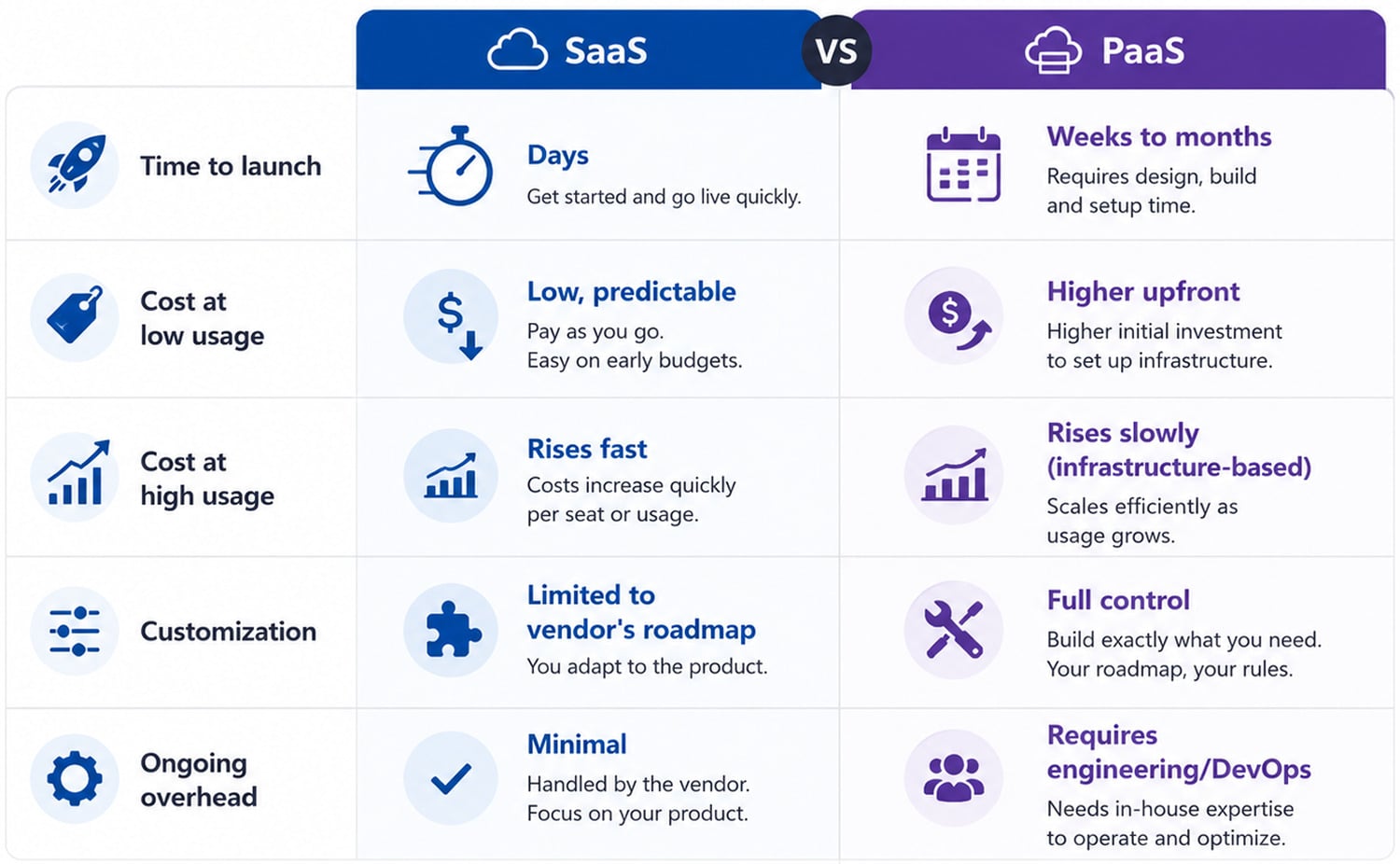
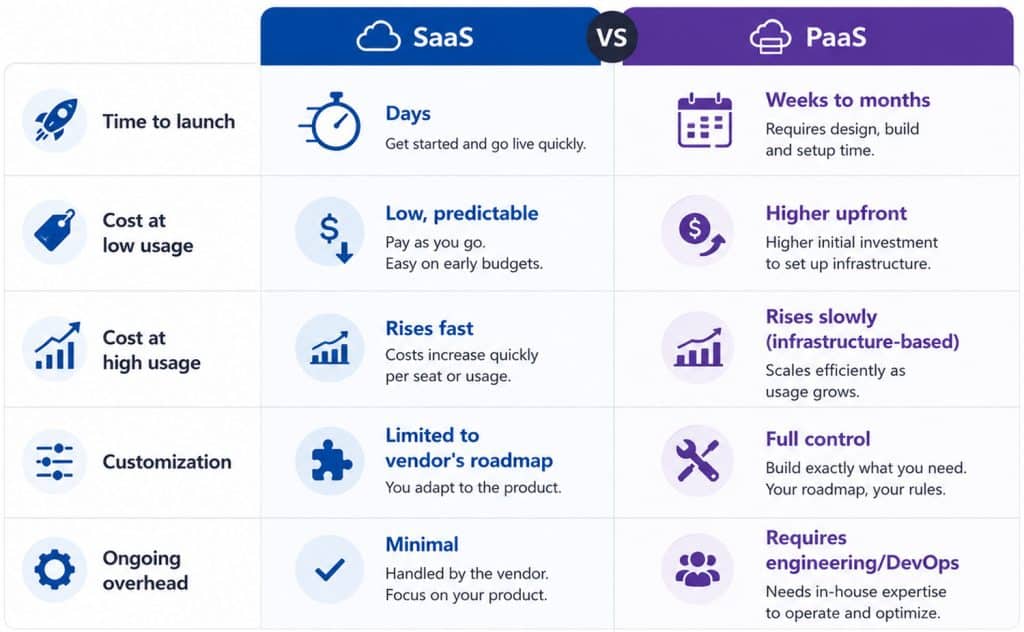
SaaS costs start low and rise with every seat and usage tier. PaaS costs start higher; you pay for engineering time up front but climb more slowly once built, since you’re not paying a per-user tax on your own product.
This isn’t a rounding error. Flexera’s 2026 State of the Cloud Report found an estimated 29% of combined IaaS and PaaS spend goes to waste, the first uptick in five years, as teams adopt platform services faster than they can govern them. Owning your stack only pays off if you’re deliberate about what you build.
3 Startup Scenarios, 3 Right Answers
| Early-stage MVP: Testing whether people want the product at all. Staying on SaaS every week on infrastructure is a week not spent talking to customers. |
| Mid-stage, scaling fast: A SaaS tool is now why a big client can’t onboard, or margins shrink with every seat. The real move: rebuild just the one or two components actually blocking growth, not the whole stack. |
| Enterprise-bound: Chasing contracts requiring data residency, white-labeling, or compliance no SaaS vendor offers standard. Here, PaaS or a custom build usually isn’t optional; it’s the cost of the deal. |
The Hybrid Path Most Companies Actually Take
Few companies pick one model and stay there. 73% now run a hybrid setup, per Flexera’s 2026 research, pairing SaaS for commodity functions with owned platforms for whatever makes their product different. Payroll and email stay on SaaS; the features a competitor can’t copy get built on PaaS.
Not sure which pieces belong in which bucket?
Helius Work audits both sides: from where a PaaS migration makes sense to where a lean custom build beats another subscription.
Questions to Ask Before You Decide
- Is this feature core to why customers choose us, or a commodity every competitor also buys off the shelf?
- Will our current pricing model still make sense at 10x our user base?
- Do we have (or can we hire) the engineering capacity to own this long-term?
- Is a compliance, security, or white-label requirement blocking a deal today?
- Are we solving a real bottleneck, or chasing “control” we don’t need yet?
Summary
SaaS vs PaaS isn’t a one-time fork in the road; it’s an ongoing calibration. Startups that scale smoothly aren’t the ones who pick a side early; they’re the ones who keep re-checking what fits as they grow. Rent what’s commodity. Own what’s core.