


- Why Low-Code Development Matters Today?
- What is Low-Code Development?
- Low-Code vs. No-Code: Understanding the Difference
- Top Advantages of Low-Code Technologies
- How Low-Code Drives Business Innovation and Digital Transformation
- Common Enterprise Use Cases for Low-Code Applications
- The Role of AI in Low-Code Development
- Steps for Implementing Low-Code Successfully
- Real-World Examples of Low-Code in Action Across Industries
- Explore Future Trends in Low-Code Platforms
If you’ve ever waited months for a new application from your IT team, you know how slow and frustrating the process can be. Traditional software development is complex: coding, testing, deployment, and troubleshooting can stretch a project over several months, sometimes even years. But today, there’s a faster, smarter way to build applications: low-code development.
Low-code platforms enable teams to create apps using visual drag-and-drop tools, pre-built components, and automated workflows, thereby minimizing the need to write lengthy lines of code. The impact is transformative. By 2026, 70–75% of new enterprise applications are expected to be built using low-code, up from less than 25% in 2020. In fact, some teams are reporting fully functional apps built in under three months, a process that used to take half a year or more.
Read along to explore how low-code empowers professional developers and citizen developers alike. Know how it enables organizations to respond to market changes quickly, innovate faster, and save costs without sacrificing quality.
Why Low-Code Development Matters Today?
Digital transformation is no longer optional. Companies are under constant pressure to innovate, adapt, and respond to ever-changing customer expectations. Yet, the global shortage of developers estimated at over 4 million has created a serious bottleneck, while demand for new enterprise applications grows five times faster than IT can deliver.
Low-code development addresses this challenge head-on. By simplifying app creation, organizations can build applications faster, reduce reliance on large developer teams, and optimize workflows. Low-code isn’t just convenient, it’s a strategic imperative for businesses that want to stay competitive.
What is Low-Code Development?
Low-code is a software development approach that reduces manual coding by using visual tools, pre-built components, and automation features. Developers and non-technical employees alike can drag and drop elements, define workflows, and configure business logic with minimal coding.
Visual Development with Drag-and-Drop Interfaces
Low-code platforms offer an intuitive visual interface where forms, buttons, and workflows can be assembled like building blocks. This approach allows teams to focus on solving real business problems instead of wrestling with complex syntax or backend coding.
Model-Driven Development
A key principle of enterprise low-code platforms is model-driven development (MDD). Developers create high-level models that outline the app’s data structure, behavior, and user interface. The platform then automatically generates the underlying code and infrastructure, reducing errors, accelerating deployment, and maintaining flexibility.
Reusable Components
Low-code platforms rely on prebuilt components and reusable modules, allowing developers to reuse common elements across applications. This increases consistency, reduces repetitive coding, and accelerates delivery timelines.
Low-Code vs. No-Code: Understanding the Difference

While often mentioned together, low-code and no-code platforms serve different audiences.
Low-Code: Flexibility for Developers
Low-code is primarily for developers and IT teams who want to speed up development without sacrificing customization. It allows for:
- Advanced workflow automation
- API and database integrations
- Enterprise-grade scalability
- Fine-tuning of business logic and user interfaces
No-Code: Simplicity for Business Users
No-code platforms, on the other hand, target non-technical users, allowing them to create simple applications quickly using drag-and-drop tools. While no-code is fast and accessible, it has limited customization and is best suited for small projects, department-specific apps, or simple automation tasks.
In short, low-code balances speed and flexibility, while no-code prioritizes simplicity over complex functionality.
Top Advantages of Low-Code Technologies
- Faster Development: Low-code reduces development cycles by up to 90%, allowing apps that normally take 3–6 months to be built in just 8–12 weeks.
- Cost Efficiency: By reducing reliance on large developer teams, businesses save more. Companies report 50–70% reductions in development costs and shorter payback periods of around six months.
- Improved Productivity: Low-code allows non-technical employees to build their own apps, freeing developers to focus on complex or high-priority projects.
- Improved App Backlog Management: Organizations using low-code report faster resolution of app backlogs, ensuring mission-critical solutions are delivered on time.
- Faster Time-to-Market: Low-code enables businesses to launch applications quickly, experiment with new ideas, and respond to changing market conditions with agility.
- Higher ROI: Businesses that use low-code with intelligent automation report a major increase in ROI, demonstrating clear financial and operational benefits.
How Low-Code Drives Business Innovation and Digital Transformation
Low-code isn’t just a tool; it’s a strategic driver of digital transformation.
Enabling Innovation
Applications can be iterated and improved quickly, allowing companies to respond to customer feedback and market changes without lengthy development cycles.
Empowering Citizen Developers
Non-technical employees can contribute to software creation, fostering a culture of innovation and problem-solving. Teams can take ownership of solutions, improving engagement and accelerating digital initiatives.
Common Enterprise Use Cases for Low-Code Applications
- Internal Workflow Automation: Document approvals, HR onboarding, and finance processes.
- Customer-Facing Apps: Portals, mobile apps, e-commerce platforms.
- Data Integration & Business Intelligence: Dashboards, reporting tools, analytics.
- Rapid Prototyping: Validate ideas, gather feedback, iterate before full-scale deployment.
- Industry-Specific Applications: Travel booking systems, loyalty programs, dynamic pricing engines.
The Role of AI in Low-Code Development
Modern low-code software development platforms increasingly integrate AI capabilities, making development smarter and faster:
- AI-assisted code generation: Generates code from natural language prompts.
- Workflow automation: Automates repetitive tasks and optimizes processes.
- Predictive analytics: Helps identify patterns, trends, and insights for better decision-making.
For example, AI-powered chatbots for customer service can be deployed in weeks instead of months, while automated finance workflows flag anomalies and trigger actions without human intervention.
Steps for Implementing Low-Code Successfully
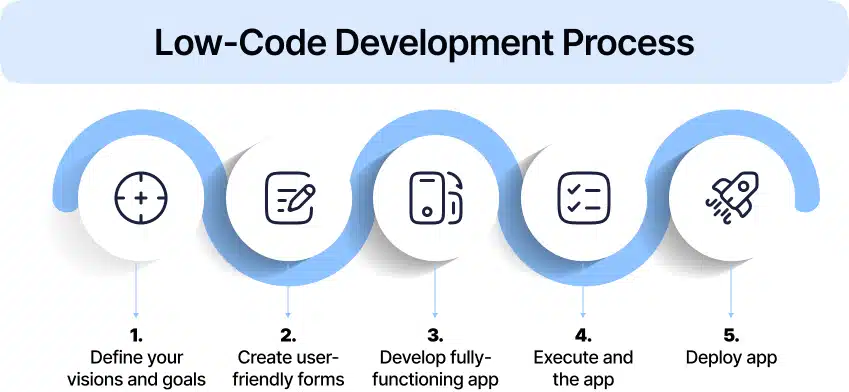
- Define Requirements and Use Case: Identify the problem you’re solving, understand user needs, and outline goals before development begins. Start with a simple project to learn the platform and deliver early value.
- Choose the Right Platform and Plan Ahead: Compare platforms based on features, scalability, and integration needs. Work with IT to ensure compatibility and define a flexible architecture that supports future growth.
- Train Your Team and Begin Building: Provide basic training so users and developers can collaborate effectively. Use templates, reusable components, and automation tools to accelerate development without sacrificing quality.
- Test and Deploy Thoughtfully: Run thorough testing to validate functionality, security, and user experience. Deploy strategically and ensure users have support as the app goes live.
- Monitor, Iterate, and Improve: Track performance, gather feedback, and make improvements regularly. Low-code thrives on continuous enhancement, not one-time delivery.
Real-World Examples of Low-Code in Action Across Industries
Many enterprises have leveraged low-code to modernize operations and accelerate innovation:
- Travel & Hospitality: Mobile hotel apps, AI-guided tours, loyalty programs increased engagement and revenue.
- Finance: Automated invoice processing dramatically reduced review times.
- HR: Resume analysis and onboarding automation cut time-to-hire by 40%.
- Manufacturing & Supply Chain: Predictive maintenance dashboards and workflow automation improved operational efficiency.
These real-world applications show low-code’s ability to deliver measurable results quickly.
Explore Future Trends in Low-Code Platforms
Low-code platforms continue to evolve, driven by AI, cloud adoption, and enterprise demand. Future trends include:
- AI-driven development: Platforms generating applications from user inputs.
- Enterprise adoption: Becoming standard for mission-critical apps.
- Improved security & compliance: Stronger governance, authentication, and audit features.
- Growth of citizen development: Increasing contribution from non-technical teams.
Businesses that embrace these trends can gain a competitive edge and build scalable digital capabilities.
Experience Low-Code Revolution with Helius Work!
We understand that speed, efficiency, and innovation are important for modern businesses. Low-code development is more than just a platform, it’s a way to empower teams to solve problems faster, improve collaboration, and deliver business value at scale.
By combining low-code tools with AI-driven automation, Helius Work enables both developers and citizen developers to create applications that are scalable, secure, and adaptable to changing needs. Organizations can reduce costs, improve productivity, and accelerate time-to-market, all while building a culture of innovation.
Low-code bridges the gap between ideas and execution. With Helius Work, that bridge is seamless, collaborative, and transformative, giving businesses the tools they need to stay ahead in a competitive digital landscape.